"USAID Measuring Impact Conservation Enterprise Retrospective (Nepal; Asian Network for Sustainable Agriculture and Bioresrouces)" by USAID Biodiversity & Forestry is marked under CC PDM 1.0. To view the terms, visit https://creativecommons.org/publicdomain/mark/1.0/
About the Sustainability Management Major (only as 2nd major)
Many businesses have started to embrace environmental and social sustainability as part of their strategic goals. This major, the first of its kind in Singapore, develops a basic understanding of issues such as climate change, marine pollution, the depletion of natural resources, and poverty. The interdisciplinary nature of the major includes courses in various business and non-business disciplines, covering a variety of perspectives and tools needed to help firms, and in selected situations, government and the non-profit sector, to make meaningful impact.
Why Major in Sustainability Management?
Sustainability is rapidly increasing in importance in the business and policy world, as governments and businesses are forced to deal with the catastrophic consequences of human actions, lifestyles and patterns of industrialization. Sustainability is most commonly defined as development that meets the needs of the present without compromising the ability of future generations to meet their own needs (Brundtland Commission Report, 1987). It involves considering three areas of societal importance in cohesion: economic growth, human development and the environment.
With this major, students will be prepared to enter a variety of jobs and occupations in the business or public sector areas. Entry-level job titles that the major can qualify one for includes sustainability programme manager (product manufacturing firm), manager of programmes and partnerships (foundation), sustainability reporting (ESG) and enterprise risk management associate (professional services [consulting] firm), and environment, social and governance (ESG) market lead, and ESG investment analyst (if together with a finance background). For more details, students may view the Know-Thy-Major slides at this link.
Curriculum
Sustainability is about tackling multidimensional real-world problems in practical and effective ways, sometimes through the collaboration of business with civil society and public policy organizations. The sustainability management major gives students a broad foundation for understanding how businesses and other organizations can tackle these varied problems by developing the ability and means to positively impact on social and environmental dimensions through their operations. To accomplish this, students select courses in the major that examine how to improve business sustainability via the various business functions (i.e., the activities of finance, supply chains, marketing, and strategy). A second group of courses allows students to comprehensively understand various sustainability issues, ranging from poverty to climate change (alternatively, students may elect to take additional courses in business sustainability). A third integrative component involves the core course and a more action-oriented SMU X course to develop or design business and value propositions that are more sustainable in social or environmental ways.
Students are required to complete the following courses:
Sustainability Management and Governance
SMU-X Sustainability Project*:
Sustainable Entrepreneurship Practicum or
Corporate Sustainable Product and System Design
Students are required to complete 6 CUs of Sustainability Management Second Major Electives. These must include 2 CUs from the following:
Finance/ Finance for Law
Financial Accounting/ Financial Accounting for Law
Marketing
Management Communication
Management of People at Work
Operations Management
Strategy
Students may fulfil the remaining requirement by completing 4 CUs of other Sustainability Management Major Electives (at least 2 CUs from Basket A and the remaining CUs from Basket A or B), such as:
Basket A (At least 2 CUs)
Sustainable Finance
Sustainable Operations
Sustainable Marketing
Sustainable Entrepreneurship
Sustainable Shipping and Ports
Organisational Aspects of Sustainable Innovation
Sustainability Study Mission (Asian Studies or Globalisation) ^
Sustainable Growth in ASEAN: Singapore, Malaysia, and Indonesia (0.5 CU course)
Social Entrepreneurship Challenge in the Indo-Pacific
Sustainability Law and Policy (0.5 CU course) / Sustainability Law (mutually exclusive courses)
* For students who take both Sustainable Entrepreneurship Practicum and Corporate Sustainable Product and System Design, one course will fulfil the SMU-X Sustainability Project requirement and the other will fulfil Basket A.
^ Students may enrol in multiple Study Missions but only one of the sections may be used to count towards a Sustainability Management Second Major elective. Business Study Mission (Germany) offered in AY2019-20 Term 1 could be used to fulfil the requirement.
About the Digital Business Major (only as 2nd major)
Artificial intelligence (AI) and digital technologies are transforming business, government, and society rapidly and profoundly both in Singapore and beyond. More and more businesses are going digital and there is fast growing demand for talents that have up-to-date ideas, skills, tools and solutions to help these organizations stay ahead of the curve in this AI/digital age. The new wave of digital business is being shaped by Large Language Models (LLM) and AI agents, systems that do not merely answer questions, but plan, reason, and execute multi-step business workflows on behalf of their users. For businesses, this means that routine functions across supply chain coordination, customer engagement, marketing analytics, financial reporting, and HR operations can increasingly be delegated to agent teams that collaborate with human employees, reshaping organisational structures, decision rights, and the very definition of productivity.
The Digital Business major provides students with a comprehensive understanding of AI and digital technologies, design tools, business models, and management skills to navigate such society-wide digital transformation frontier with confidence. It is a pedagogical imperative to ensure our graduates can utilize appropriate AI and digital tools effectively in real business context and become ready to lead digital transformation in firms where humans, data, and AI agent work side-by-side.
The major is jointly developed and offered by LKCSB and SCIS. The curriculum integrates SCIS' strength on technical and programming courses and LKCSB's forte on business and management courses, combining technical capabilities with business applications. Students not only develop depth in data engineering, analytics, AI governance, security, ethics, and LLM technologies, but also learn to apply these capabilities to AI-powered business functions such as customer support, marketing and sales, product and R&D development, HR, operation workflow, and decision support in real organisational settings. This structure ensures that graduates from this major understand both the underlying technical infrastructure and the strategic levers for value creation. Students will learn both technical and managerial tools to be well equipped to solve business problems and create new ideas in the thriving AI/digital economy.
The knowledge acquired in this major has wide-ranging applications in a variety of industries, as well as government and other types of organizations. The major aims to give our graduates an edge in those contexts where the integrative knowledge of digital technologies and business administration will create the biggest value. Some examples of the typical jobs include consultant for digital business and digital transformation, business analysts, social media expert, e-commerce analyst, social-commerce specialist, digital marketing specialist, digital delivery, digital payment, process automation analyst, and business intelligence analyst etc. The career possibilities are expanding quickly.
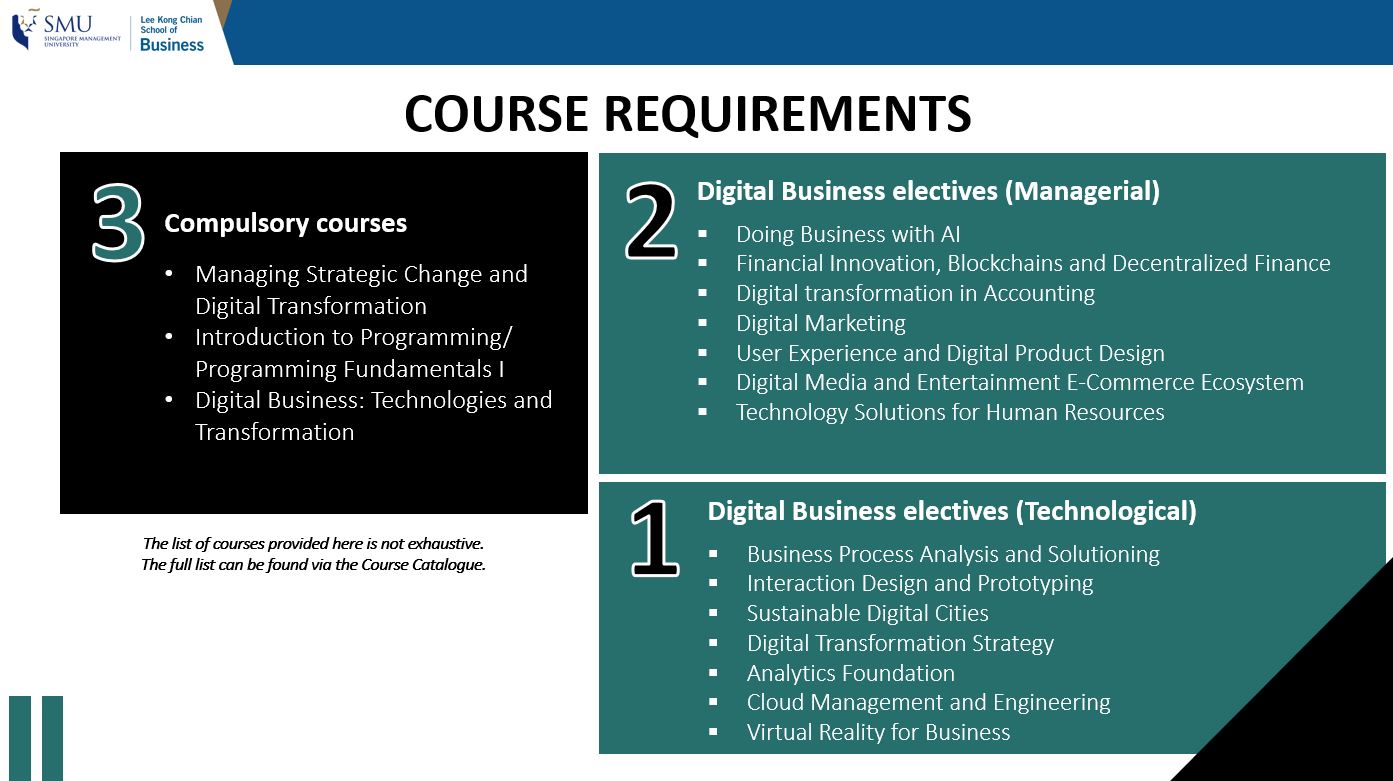
The major requires 3 units of compulsory core courses and 5 units elective courses (3 must be from Digital Business major elective). The BBM students and non-BBM students might take different routes to fulfill the credit requirements. Please refer here for more details on the curriculum and course description.
The Innovation & Entrepreneurship major is for undergraduates who want to make an impact through new venture creation, leading corporate innovations, or spearheading business growth plans. Through electives, an entrepreneurship practicum, and study missions to entrepreneurial hubs globally, you will gain a foundation for applying the tools and techniques to start new ventures, lead corporate innovation, and scale your impact.
Why major in Innovation & Entrepreneurship?
The Innovation & Entrepreneurship major will appeal to students interested in the fast-paced world of high-growth start-ups, as well as those who want to launch impactful new ventures, lead corporate innovations, or spearhead business growth plans. Unlike other majors that prepare students for specific corporate functions, courses in the Innovation & Entrepreneurship major prepare students to succeed in less structured entrepreneurial environments. Hence, the Innovation & Entrepreneurship major is highly complementary as a second major because having the skills to start and scale new ventures will improve your career prospects and job opportunities.
Current students may refer to the Course Catalogue on OASIS for the most updated list of electives available and their course attributes.
Academic Advisor
Any questions about our major? Please contact our academic advisor:
Associate Prof. Kenneth Goh: kennethgoh@smu.edu.sg
“One of the most enjoyable courses I have taken because of how tangible it is. We were encouraged to get our hands “dirty” which enhanced the experience even further. I valued the learning from the course. It covered the whole breadth of business and required us to examine start-up issues from multiple lenses (founder, investor, customer, etc.).”
Ronnie Lye Kian Wei
MGMT218, AY2021 Term 1
"The course provided us with a platform to explore our ideas while also refining our thought processes and expanding the scope for possibilities. I found the course excitingly different from other modules as it more accurately reflected the twists and turns of Entrepreneurship."
Nicolas Koh
MGMT 223, AY 2020 Term 1
About the Strategic Management Major
Understand how organisations - from start-ups to multinationals - formulate strategies, design structures, and manage their businesses to be competitive in a dynamic environment.
Curriculum
1 Compulsory Course:
Introduction to Organisations
2 Strategic Management Electives from the following:
Corporate Strategy
International Business
Management of Technology and Innovation
Managing Strategic Change and Digital Transformation
3 other Strategic Management Electives Some examples of Strategic Management electives:
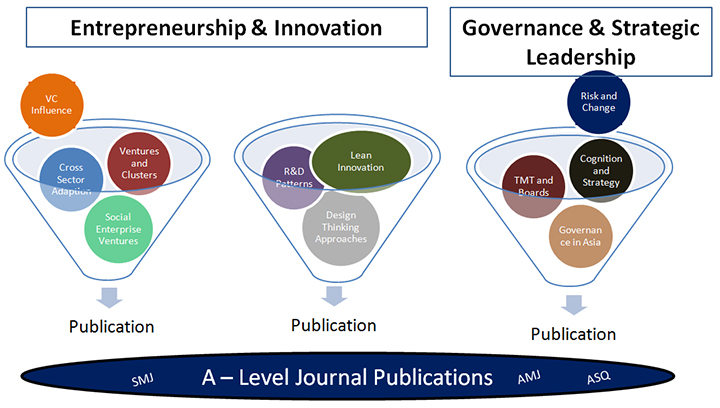
The Strategy and Organization area can make a great impact through research, practice, education, and service.
1. Publishing in ‘A’ Journals…
to be a top-ranked strategy group in research
While our research interests areas are dynamic, we look to find synergy within our S&O team (as a cluster) to further our collective impact.
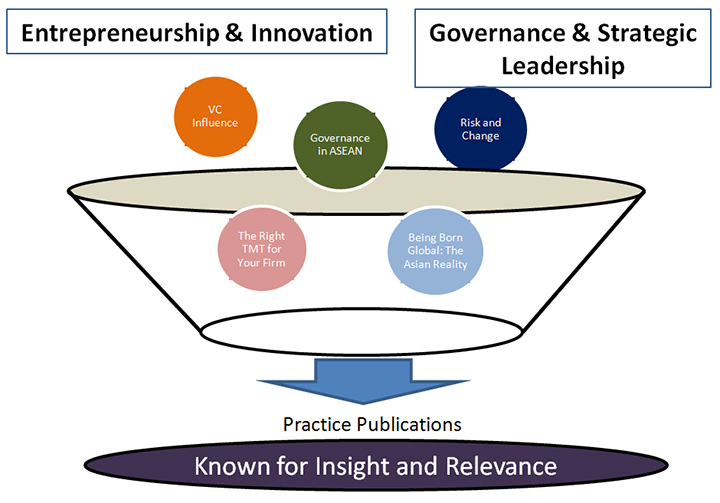
2. Writing for Practice…
to showcase our insights and relevance for business community
By aligning our practice orientation to our research areas, we can have more relevant impact and bridge research and practice.
3. Innovative Education…
to be known for innovative programme and courses
4. High Quality Teaching…
our graduates are known for their capability
This programme is designed to equip students with the skills, knowledge and competencies to conduct high-quality research in the areas of strategic management and organisations. Students can choose their research topics from a variety of sub-areas within the domains of strategic management and organisation theory, including corporate and business strategy, innovation, technology management, entrepreneurship, and corporate governance.
The programme provides rigorous training by faculty members who regularly publish in top academic journals. This ensures that students will be well equipped to start their academic careers as competent and independent researchers.
Singapore Management University’s Strategy & Entrepreneurship group invites applications for multiple tenure-track faculty position across all levels (Assistant Professor, Associate Professor, and Full Professor).
We are seeking leading experts particularly in Entrepreneurship and Innovation, but also from one of the following broadly defined areas of Strategic Management, International Business, Organizational Theory (Macro), Environmental Sustainability and CSR, and Technology Management and Digitalization (including AI). We expect candidates to be conducting rigorous, impactful, and interesting research, and have top-tier publishing and research records (e.g., AMJ, AMR, ASQ, Org Sci, SMJ, etc) commensurate with the rank they are applying for.
SMU offers an internationally competitive compensation and research support package including relocation benefits and child education funding.
About the Strategy and Entrepreneurship Area: The Strategy and Entrepreneurship Area currently has 25+ tenure-, practice- and teaching-track faculty members from over 10 different nationalities. They conduct high-quality research published in top research journals and have extensive editorial experience. Senior faculty members include Ilya Cuypers, Gokhan Ertug, Reddi Kotha, Heli Wang, Daphne Yiu among others. General information about SMU can be found at www.smu.edu.sg and information about the Strategy & Entrepreneurship area at: Strategy and Entrepreneurship Welcome page.
Candidates should submit a full application by 15 September 2026 consisting of:
a letter with their research and teaching statement,
a CV,
three samples of research,
evidence of teaching ability, and
three letters of reference.
Full Professors and established Associate Professors may send just a cover letter and CV to managementcv@smu.edu.sg and liangchen@smu.edu.sg with the subject heading “Tenure-track Application”, and will be considered on an ongoing-basis until the position is filled.
Our senior faculty members are available for conversations at the AOM and SMS conferences. Contact liangchen@smu.edu.sg for more details.